You want to help your team understand each other better, and two names keep coming up: DiSC and MBTI. Both describe differences between people. Both have been used in organisations for decades. So which one should you choose?
The right answer depends less on the tool than on your need. The MBTI® and Everything DiSC® do not look at the same thing and do not serve exactly the same purposes. In fact, they often complement each other.
In this article, we explain what each one measures, how they differ, and how to choose based on your situation.
The MBTI®: understanding your personality preferences
The Myers-Briggs Type Indicator (MBTI®) was developed in the 1940s by Katharine Cook Briggs and her daughter Isabel Briggs Myers. It draws on the theory of psychological types published in 1921 by the Swiss psychiatrist Carl Gustav Jung.
The MBTI® describes your preferences across four dimensions:
- Extraversion (E) or Introversion (I): where you draw your energy from;
- Sensing (S) or Intuition (N): how you take in information;
- Thinking (T) or Feeling (F): how you make decisions;
- Judging (J) or Perceiving (P): how you approach the outside world.
The combination of these four preferences gives one of 16 types (for example ISTJ or ENFP). The questionnaire is administered by certified practitioners.
Its strength: a rich reading of personality as a whole, useful for self-awareness, career guidance and personal development. As its publisher, The Myers-Briggs Company, points out, it should never be used for recruitment: it measures preferences, not skills.
Everything DiSC®: understanding behaviour at work
The DiSC model originates in the work of American psychologist William Moulton Marston, published in 1928. Everything DiSC® is its modern version, developed and validated by the publisher Wiley.
It describes observable behaviour at work using two axes: pace (more active or more thoughtful) and focus (more on tasks or more on people). These axes form four styles:
- D (Dominance): direct, results-oriented;
- i (Influence): enthusiastic, people-oriented;
- S (Steadiness): dependable, cooperative;
- C (Conscientiousness): precise, analytical.
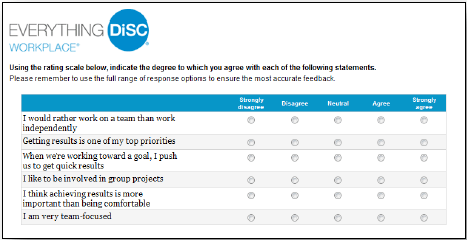
Rather than a fixed type, each person is placed as a dot on a circle: you see their dominant style, but also its intensity and nuances. The questionnaire is adaptive: it adjusts its questions based on your answers to gain precision.
Its strength: a simple language that everyone remembers after a single session, applied directly to working life: communicating, handling conflict, managing, selling. Like the MBTI®, it is not designed for recruitment.
DiSC and MBTI at a glance
| MBTI® | Everything DiSC® | |
|---|---|---|
| What it describes | Personality preferences | Observable behaviour at work |
| Foundation | C. G. Jung’s theory of types (1921) | W. M. Marston’s work (1928) |
| Result | One of 16 types (e.g. ENFP) | One of 4 styles, precisely placed on a circle |
| Level of analysis | The whole person | The person in a work setting |
| Ease of recall | Takes time to absorb (4 letters, 16 types) | Immediate (4 styles) |
| Typical uses | Self-awareness, career guidance, personal development | Communication, team cohesion, management, conflict, sales |
| Recruitment | Not recommended by the publisher | Not recommended by the publisher |
| Administration | By a certified practitioner | Through an authorised Wiley partner or a certified practitioner |
Neither is “better” in absolute terms: they answer different questions.
Which tool should you choose for your needs?
The MBTI® is often the right choice if:
- you are supporting an individual in an in-depth reflection on themselves;
- you are working on career guidance or a career transition;
- you have time to explore the 16 types in depth.
Everything DiSC® is often the right choice if:
- you want to improve communication and collaboration within a team;
- you are looking for a common language that everyone remembers and uses the very next day;
- you are working on a specific issue: management, conflict, leadership, customer relationships;
- you are rolling out an approach across an organisation, with specialised profiles (Workplace, Management, Productive Conflict, Work of Leaders, Sales).
And both together? It is possible, and sometimes very valuable. A person can explore their personality with the MBTI® in individual coaching, then use Everything DiSC® to work on their team’s dynamics. The two perspectives complement rather than compete with each other.
At Learning Partners, we practise both: we have been MBTI® Step II certified for more than ten years and are an authorised Wiley partner for Everything DiSC®. This lets us point you to the tool that truly serves your goal, rather than the only one we happen to run.
In short: if your question is “who am I?”, the MBTI® offers an in-depth reading. If it is “how can we work better together?”, Everything DiSC® is generally more direct and more practical.
A real example: Red Hat France’s leadership team
Red Hat France’s leadership team, twelve people, wanted to strengthen its cohesion and alignment. The issue was not self-awareness, but how to work together day to day.
We supported them for nine months with The Five Behaviors®, Patrick Lencioni’s model published by Wiley: trust, productive conflict, commitment, accountability and results. The programme draws on each member’s Everything DiSC® style to understand how everyone contributes to the team’s dynamics.
Over a period of nine months, […] we witnessed a significant leadership transformation.
Leonard Bodmer, Revenue Leader Western Europe, Red Hat
This is a typical case where a tool focused on behaviour at work makes the difference: the question was collective and practical.
Frequently asked questions
Is DiSC simpler than the MBTI®?
It is quicker to remember: four styles, compared with sixteen types. This simplicity makes it easier to use day to day as a team. The MBTI® offers a broader reading of personality, which takes more time to absorb.
Can DiSC or the MBTI® be used for recruitment?
No. Both publishers advise against it: these tools describe preferences and behaviours, not skills. They are, however, very useful after hiring, for onboarding and management.
Can my DiSC style change?
Your core style generally stays stable, but your behaviour adapts to the context. DiSC helps you become aware of these adjustments and choose them.
Which one should I choose for a team that struggles to communicate?
For communication or collaboration issues, Everything DiSC® is generally the most practical: everyone quickly understands their own style and other people’s, and knows how to adapt.
Going further
Want a first idea of your style? Take our free 2-minute quiz.
Prefer to read at your own pace? Get our “DiSC at work” guide: the 4 styles and how to adapt your communication from tomorrow.
Considering certification? Read also: DiSC certification: 5 questions to ask yourself before choosing your training.
Free guide
Get our free guide “DiSC at work”
The 4 styles, how to recognise them and how to adapt your communication from tomorrow. 5 pages, 15 minutes of reading.